Lisa Lea Sentenced to 30 Years After High-Speed I-695 Work Zone Crash Killed Six Workers
A sentencing that closes the criminal case’s central chapter
A Baltimore County judge has sentenced Lisa Lea to 30 years in prison for her role in a March 2023 crash on Interstate 695 that killed six highway workers in a marked work zone near Woodlawn. Lea pleaded guilty in November 2025 to six counts of vehicular manslaughter, one count for each victim.
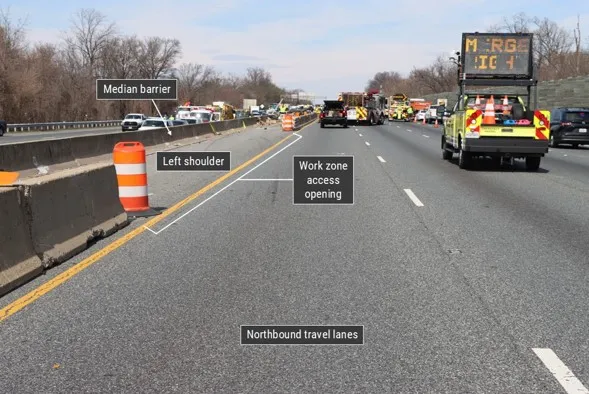
The case stems from a midday collision on March 22, 2023, on the inner loop (northbound) of I-695 near the Security Boulevard area, where a long-term work operation had closed the left shoulder and placed workers behind concrete barriers designed to separate road crews from live traffic.
What investigators determined happened on March 22, 2023
Federal investigators concluded the crash began when a 2017 Acura TLX, traveling at a recorded speed of 121 mph, moved from the right lane across the two middle lanes toward the left lane and struck a 2017 Volkswagen Jetta traveling at a recorded 122 mph. After the impact, the Acura’s driver lost control and the vehicle entered the protected work zone through an opening in the barrier system that existed to allow work-zone access.
Six workers were struck inside the work area. Maryland State Police identified those killed as Rolando Ruiz, 46, of Laurel; Carlos Orlando Villatoro Escobar, 43, of Frederick; Jose Armando Escobar, 52, of Frederick; Mahlon Simmons III, 31, of Union Bridge; Mahlon Simmons II, 52, of Union Bridge; and Sybil Lee DiMaggio, 46, of Glen Burnie.
Impairment findings and the rejected medical-event explanation
Investigators documented a measured concentration of delta-9 THC in Lea’s blood after the crash, along with the presence of cyclobenzaprine, a medication that can impair driving. The investigative record also addressed claims that a seizure may have precipitated the crash; medical records did not corroborate a seizure history, and the final investigative findings reported no indication of a sudden medical event as the cause.
The second driver’s case and how the work zone was evaluated
The Volkswagen driver, Melachi Brown, also faced criminal charges tied to speeding. Brown pleaded guilty to negligent manslaughter and received an 18-month sentence; he was later released early and ordered to complete home detention.
Investigators assessed the work zone’s layout and concluded it met applicable state and federal standards. The barrier system prevented Brown’s vehicle from entering the work area during the initial sequence, while the access opening became the pathway through which Lea’s out-of-control vehicle entered after the high-speed collision.
Policy changes that followed: work-zone enforcement and operational adjustments
In the wake of the fatal crash, Maryland agencies and lawmakers advanced changes aimed at reducing risk to road crews. A work-zone speed enforcement law took effect June 1, 2024, increasing automated-speed-enforcement penalties, with a tiered fine structure effective January 1, 2025. The law also expanded the allowable use of speed cameras in larger work zones and updated requirements for signage and lighting to better indicate when workers are present.
June 1, 2024: work-zone automated speed enforcement fines increased to $80 for qualifying violations.
January 1, 2025: a tiered fine schedule took effect, with higher penalties as speeds increase above the posted limit; fines are doubled when workers are present.
The I-695 case combined criminal accountability with a broader transportation safety review of how speed, lane changes, and work-zone access points can interact with catastrophic consequences.